How Often Should a Septic Tank Be Pumped and Serviced in North Carolina?
Plan on a professional inspection at least every three years. For a typical household, plan on a pump-out every three to five years. That is the EPA’s guidance. The North Carolina Division of Public Health says the same about pumping.
North Carolina’s own rule is a measurement, not a date on a calendar. Rule 15A NCAC 18E .1303 sets the trigger. The tank gets emptied when both the scum and the sludge pass one third of the liquid depth. Someone has to open the tank and measure to know. That is the work a septic maintenance plan does for you.
What does the North Carolina rule actually say?
Rule .1303 covers what a system owner is responsible for. The pumping trigger above is checked in any compartment. The same rule says the effluent filter shall be rinsed of accumulated solids, or replaced as needed. A loaded filter can back wastewater up into the house or clog the system.
The rule also asks owners to keep vegetation growing over the system. Soil disturbance and soil compaction over the dispersal field are out. Your county health department administers all of this. The NC Division of Public Health points homeowners to that local office for questions, permits and inspections.
What does the EPA recommend?
The EPA says the average household system should be inspected at least every three years. That is a job for a septic service professional. Typical pumping runs every three to five years. Systems with float switches, pumps or other mechanical parts need checking more often, generally once a year.
The EPA names four things that set the pace. They are household size, the total wastewater generated, the volume of solids in it, and tank size.
How often should my tank be pumped for my house?
NC State Extension publishes a table for this, adapted from published research on solids build-up. It estimates years between pump-outs by tank size and by household size.
| People in the house | 900 gallon tank | 1,000 gallon tank | 1,250 gallon tank | 1,500 gallon tank |
|---|---|---|---|---|
| 1 person | 11 years | 12 years | 16 years | 19 years |
| 2 people | 5 years | 6 years | 8 years | 9 years |
| 4 people | 2 years | 3 years | 3 years | 4 years |
| 6 people | 1 year | 2 years | 2 years | 3 years |
| 8 people | under 1 year | 1 year | 1 year | 2 years |
Most North Carolina homes sit in the 1,000 gallon column. Rule 15A NCAC 18E .0801 sets 1,000 gallons as the minimum septic tank. It sizes a house of four bedrooms or fewer at 1,000 gallons, and five bedrooms at 1,250.
Extension treats that table as the fallback. Its first choice is a professional watching the rate of solids build-up in your tank every year. Use the table when the tank is hard to reach and nobody is measuring.
How do you know when it is time?
The only real answer is to measure. A diagnostic septic inspection opens the tank and reads scum and sludge depth against the liquid depth. It also covers the baffles, the filter and the ground over the field. That turns the state’s one third rule into a yes or no for your house. These are diagnostic visits, not real estate or point-of-sale inspections, which need a state certified inspector in North Carolina.
Between visits, watch what you can see. Slow drains, a gurgling toilet, a soggy patch over the field, a sewage smell in the yard. Any of those means the system needs attention now.
What changes the interval?
Water volume is the biggest lever. More people, more laundry and longer showers push solids toward the outlet before they settle.
A garbage disposal matters more than most homeowners expect. NC State Extension says disposals usually double the solids added to the tank. The EPA advises cutting disposal use for the same reason.
A water softener is worth a look. Extension says the backwash discharge should not be connected to the waste plumbing or the septic tank.
An effluent filter on the tank outlet shifts the picture too. It holds hair, lint and undigested solids back from the drain field. Extension puts filter service at roughly every two to three years. A loaded filter looks like a failing system from inside the house. Drains slow, toilets gurgle, and water sits high in the tank.
An aerated tank runs on a different clock. Add an aeration and bacteria unit inside the tank and the chemistry changes. Oxygen and live bacteria digest much of the organic solids instead of storing them. Solids build up more slowly, so pumping needs drop. The North Carolina rule still applies at that one third mark.
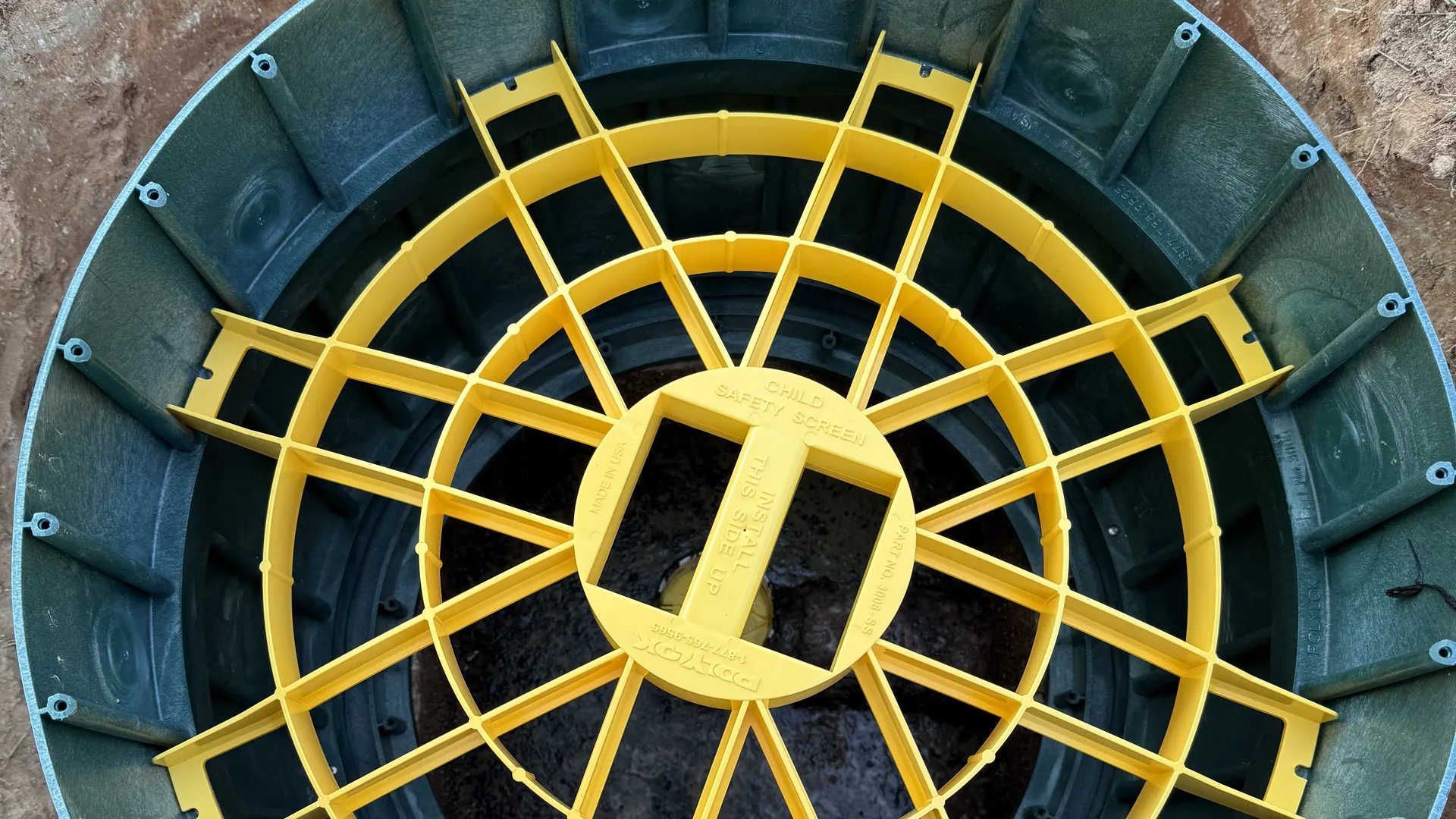
If the lids are buried under grass, every visit starts with a shovel. Septic tank risers bring the access up to ground level.
What should a septic maintenance plan include?
Every visit should cover the same short list. Check the equipment and the air pump. Clean the effluent filter. Inspect the tank and the drain field, and add bacteria. Record the numbers so the next visit has something to compare.
Everclear’s schedule starts heavy and settles down. Year one comes with an install and runs three visits, at about 30 days, 6 months and one year. After that it is two visits a year. Once a system is stable it drops to one visit a year with an annual bacteria treatment.
Pumping is a separate trade. Everclear does not pump tanks. When a tank measures out at the one third mark, we say so and point you to a pumping company.
What does septic tank maintenance cost?
The EPA puts regular septic maintenance fees at $250 to $500 every three to five years. It sets that against $5,000 to $15,000 to repair or replace a failed conventional system. That gap is the argument for staying on a schedule.
National cost guides tracking 2026 prices put a routine pump-out here:
| Tank size | Typical pump-out range |
|---|---|
| 750 gallons | $250 to $550 |
| 1,000 gallons | $325 to $700 |
| 1,250 gallons | $375 to $900 |
| 1,500 gallons | $450 to $1,100 |
Those guides put the national average near $426. Most jobs land between $291 and $564. These are market numbers from published cost guides, not our price list, and Everclear does not pump tanks. A buried lid pushes a bill toward the high end.
What does skipping service actually cost?
The EPA is plain about the risk. Household wastewater carries disease causing bacteria and viruses, plus high levels of nitrogen and phosphorus. A system that stops treating properly can contaminate groundwater and nearby surface water.
That carries more weight on a lake lot. Nutrients reaching the water feed algae. Many lake homes around Lake Norman, High Rock Lake and Lake Hickory are on septic, not sewer.
What is the first step?
If nobody has opened your tank in three years, start there. A free on-site evaluation looks at the tank and the field first. It tells you where the scum and sludge actually sit. From there you have a schedule instead of a guess.
Everclear is a North Carolina certified septic installer based in Statesville. We serve about 50 miles out, across Lake Norman, High Rock Lake and Lake Hickory country. Call or text (336) 624-7314 to go over what a service visit covers.